When people first get sober, they expect life to start improving quickly. They expect relief, clarity, maybe even happiness. Instead, many hit a stage where nothing feels good at all. Food tastes flat. Music sounds empty. Conversations feel forced. Even things that used to bring comfort seem meaningless. This state is called anhedonia, and it is one of the most misunderstood and most dangerous phases of recovery.
I want you to understand something right away. When this happens, it does not mean you are broken. It does not mean recovery isn’t working. It does not mean you need the substance again. What you are feeling is the nervous system rebuilding itself after years of being trained to depend on artificial rewards. In the Unified Flux Model, we view anhedonia as a period of energetic recalibration, when the brain, body, and field are learning to generate life from within rather than borrowing stimulation from the outside.
This stage can feel like nothing. But that nothing is not emptiness. It is repair.
I want you to understand something right away. When this happens, it does not mean you are broken. It does not mean recovery isn’t working. It does not mean you need the substance again. What you are feeling is the nervous system rebuilding itself after years of being trained to depend on artificial rewards. In the Unified Flux Model, we view anhedonia as a period of energetic recalibration, when the brain, body, and field are learning to generate life from within rather than borrowing stimulation from the outside.
This stage can feel like nothing. But that nothing is not emptiness. It is repair.
The Brain After Addiction: Why Pleasure Shuts Down
All addictive substances, alcohol, opioids, stimulants, cannabis, and even behavioral addictions affect the brain’s reward system, especially the dopamine pathways that run between the ventral tegmental area, nucleus accumbens, and prefrontal cortex. These circuits are designed to reinforce survival behaviors like eating, bonding, and learning. When substances repeatedly flood the system with dopamine, the brain adapts by reducing its natural sensitivity (Koob & Volkow, 2016).
Over time, this produces two changes:
This is called reward system downregulation. When the substance is removed, the brain does not immediately return to baseline. Instead, it enters a state where natural rewards feel weak or absent. This is why early recovery often includes:
Research on post-acute withdrawal shows that these symptoms can last weeks or months while the brain gradually restores normal dopamine function (Heilig et al., 2021). From a clinical perspective, this is neuroadaptation. From a UFM perspective, this is the nervous system relearning how to generate coherent energy without chemical amplification.
Over time, this produces two changes:
- The brain releases less dopamine naturally.
- The brain requires more stimulation to feel normal.
This is called reward system downregulation. When the substance is removed, the brain does not immediately return to baseline. Instead, it enters a state where natural rewards feel weak or absent. This is why early recovery often includes:
- Lack of motivation
- Emotional flatness
- Inability to feel joy
- Low energy
- Irritability
- The sense that life has lost meaning
Research on post-acute withdrawal shows that these symptoms can last weeks or months while the brain gradually restores normal dopamine function (Heilig et al., 2021). From a clinical perspective, this is neuroadaptation. From a UFM perspective, this is the nervous system relearning how to generate coherent energy without chemical amplification.
The Hidden Danger: Anhedonia Is a Relapse Zone
Many people relapse not when life is chaotic, but when life feels empty. The brain remembers that substances once made everything feel intense, alive, meaningful, or at least tolerable. When the system falls into anhedonia, the subconscious begins searching for the fastest way to restore stimulation.
This is why thoughts start to appear like:
These thoughts are not weakness. They are the brain trying to escape a low-dopamine state. Studies on addiction recovery show that reduced reward sensitivity is strongly linked to craving and relapse risk, especially in the early months of sobriety (Volkow et al., 2019). The system is not trying to destroy you. It is trying to return to what it learned that kept it alive.
In the Unified Flux Model, this phase is called energetic depletion, the period when the field has stopped running on artificial fuel but has not yet rebuilt its natural current.
You are not falling apart.
You are running on empty while the system rewires itself.
This is why thoughts start to appear like:
- Nothing matters anyway.
- One time wouldn’t hurt.
- I just want to feel something.
- Life was easier when I was using.
These thoughts are not weakness. They are the brain trying to escape a low-dopamine state. Studies on addiction recovery show that reduced reward sensitivity is strongly linked to craving and relapse risk, especially in the early months of sobriety (Volkow et al., 2019). The system is not trying to destroy you. It is trying to return to what it learned that kept it alive.
In the Unified Flux Model, this phase is called energetic depletion, the period when the field has stopped running on artificial fuel but has not yet rebuilt its natural current.
You are not falling apart.
You are running on empty while the system rewires itself.
Energetic Interpretation: When the Field Contracts
Addiction overstimulates the nervous system for so long that the body forgets how to regulate itself without external input. When the substance stops, the energetic field often collapses inward. People describe feeling smaller, duller, disconnected, or numb. This is not only psychological. It shows up physically as:
In UFM language, the system has moved from overcharged instability to undercharged contraction. Neither state is healthy, but contraction is part of the reset. The field is conserving energy while the brain rebuilds its natural circuitry.
Think of it like a muscle after injury. Before it becomes strong again, it becomes weak. The weakness is not failure. It is the stage before growth.
Anhedonia is the nervous system saying,
“I am rebuilding. Do not overload me yet.”
- Low drive
- Slowed thinking
- Reduced emotional range
- Fatigue
- Social withdrawal
In UFM language, the system has moved from overcharged instability to undercharged contraction. Neither state is healthy, but contraction is part of the reset. The field is conserving energy while the brain rebuilds its natural circuitry.
Think of it like a muscle after injury. Before it becomes strong again, it becomes weak. The weakness is not failure. It is the stage before growth.
Anhedonia is the nervous system saying,
“I am rebuilding. Do not overload me yet.”
Why Recovery Feels Worse Before It Feels Better
One of the hardest truths in healing is that removing the substance does not instantly create happiness. In fact, for a period of time, life can feel worse than it did while using. This happens for three reasons:
During addiction, the substance becomes part of who a person believes they are. When it disappears, a gap remains. The old identity is gone, but the new one has not formed yet. That gap feels like emptiness, but it is actually a transition.
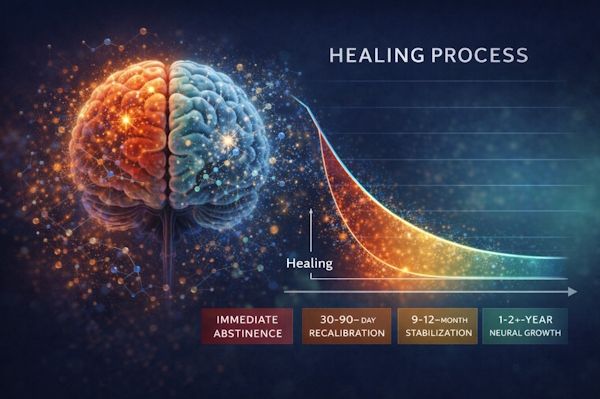
Neuroscience research shows that recovery involves gradual restoration of prefrontal regulation and reward responsiveness, which can take months or longer depending on the severity and duration of use (Volkow et al., 2019). This timeline matches what many people experience: the first stage is not joy, it is neutrality.
In UFM, we call this stage the silent phase of reconstruction.
Nothing feels good yet, but the system is learning how to feel again.
- First, the brain’s reward system is suppressed.
- Second, emotional pain that was numbed begins to surface.
- Third, identity has not yet reorganized around a sober self.
During addiction, the substance becomes part of who a person believes they are. When it disappears, a gap remains. The old identity is gone, but the new one has not formed yet. That gap feels like emptiness, but it is actually a transition.
Neuroscience research shows that recovery involves gradual restoration of prefrontal regulation and reward responsiveness, which can take months or longer depending on the severity and duration of use (Volkow et al., 2019). This timeline matches what many people experience: the first stage is not joy, it is neutrality.
In UFM, we call this stage the silent phase of reconstruction.
Nothing feels good yet, but the system is learning how to feel again.
Signs That Anhedonia Is Healing, Not Failure
There are certain signs that the numbness you feel is part of recovery, not proof that something is wrong:
These are signs that the nervous system is stabilizing.
Many people relapse here because they mistake calm for meaninglessness. But calm is often the first signal that the brain is coming back online.
- You can still function, even if motivation is low.
- You do not feel intense pleasure, but you also do not feel constant chaos.
- You notice small moments of calm, even if they are brief.
- You feel tired, but not destroyed.
- You sometimes feel bored instead of desperate.
These are signs that the nervous system is stabilizing.
- Chaos feels intense.
- Collapse feels empty.
- Coherence begins quietly.
Many people relapse here because they mistake calm for meaninglessness. But calm is often the first signal that the brain is coming back online.
Working Through Anhedonia in the Unified Flux Model
In the Unified Flux Model, we do not try to force happiness during this phase. We focus on restoring coherence, not chasing pleasure.
The practices we use aim to rebuild natural regulation:
These practices slowly teach the brain how to produce energy on its own again. The goal is not to feel amazing.
The goal is to become stable enough to feel real.
When stability returns, pleasure follows naturally.
The practices we use aim to rebuild natural regulation:
- Cold exposure to stimulate vagal tone
- Breathwork to regulate autonomic balance
- Physical movement to activate dopamine naturally
- Structured routine to stabilize the field
- Sunlight and sleep to reset the circadian rhythm
- Meaningful connection instead of artificial stimulation
These practices slowly teach the brain how to produce energy on its own again. The goal is not to feel amazing.
The goal is to become stable enough to feel real.
When stability returns, pleasure follows naturally.
References
Heilig, M., MacKillop, J., Martinez, D., Rehm, J., Leggio, L., & Vanderschuren, L. J. M. J. (2021). Addiction as a brain disease revised: Why it still matters, and the need for consilience. Neuropsychopharmacology, 46(10), 1715-1723. https://doi.org/10.1038/s41386-020-00950-y
Koob, G. F., & Volkow, N. D. (2016). Neurobiology of addiction: A neurocircuitry analysis. The Lancet Psychiatry, 3(8), 760-773. https://doi.org/10.1016/S2215-0366(16)00104-8
Volkow, N. D., & Boyle, M. (2018). Neuroscience of Addiction: Relevance to Prevention and Treatment. The American journal of psychiatry, 175(8), 729–740. https://doi.org/10.1176/appi.ajp.2018.17101174
Koob, G. F., & Volkow, N. D. (2016). Neurobiology of addiction: A neurocircuitry analysis. The Lancet Psychiatry, 3(8), 760-773. https://doi.org/10.1016/S2215-0366(16)00104-8
Volkow, N. D., & Boyle, M. (2018). Neuroscience of Addiction: Relevance to Prevention and Treatment. The American journal of psychiatry, 175(8), 729–740. https://doi.org/10.1176/appi.ajp.2018.17101174
Copyright © 2025
Created with